A projection in five eras

The 15-Year Map:
How AI Eats Every Occupation

The gap between what AI can do and what it's actually doing is the defining story of the next 15 years. Here's how it closes - occupation by occupation, half-decade by half-decade.

VonDoom
March 2026
12 min read
Scroll

There's a radar chart that maps AI coverage across 22 occupational categories - everything from computer science to construction, legal to landscaping. It plots two lines: theoretical capability (what AI could handle if we let it) and observed adoption (what's actually deployed in the real world).

In 2024, those two lines tell a dramatic story. The theoretical coverage is already massive in knowledge work - computer & math at 0.95, business & finance at 0.95, architecture & engineering at 0.85. AI could already do most of this work.

But observed adoption? It's a tiny cluster huddled in the center of the chart. Computer & math at 0.40. Business & finance at 0.35. Legal at 0.20. And anything requiring a physical body - construction, agriculture, installation & repair - is sitting at essentially zero.

That gap between “can” and “does” is the adoption curve. And it's about to go exponential.

I projected this forward by modeling the convergence of three forces: AI (software intelligence), robotics (physical execution), and nanotechnology (molecular-scale precision). Each one compounds the others. Here's the map, era by era.
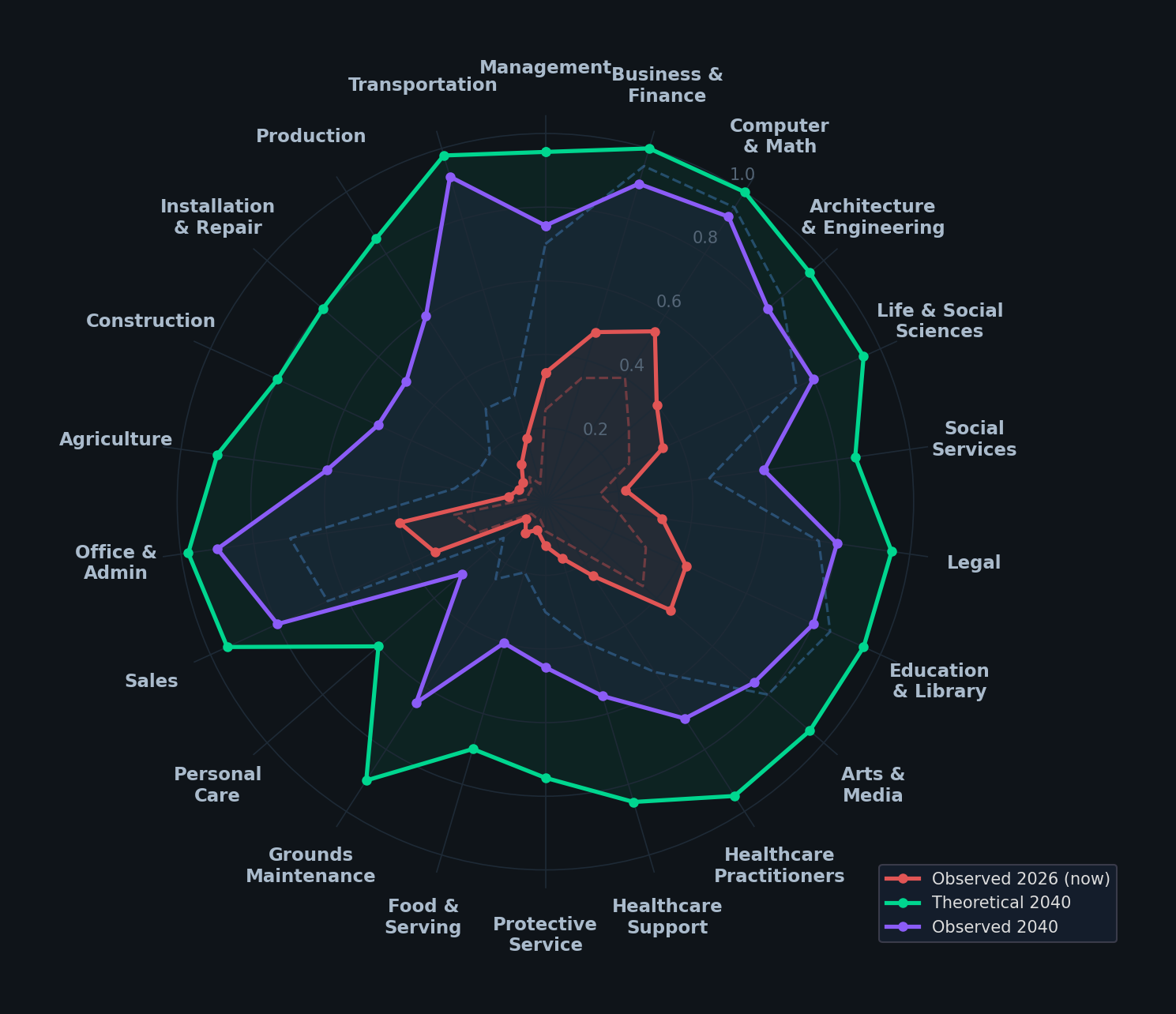
Double-click to enlarge AI coverage 2024 vs 2040
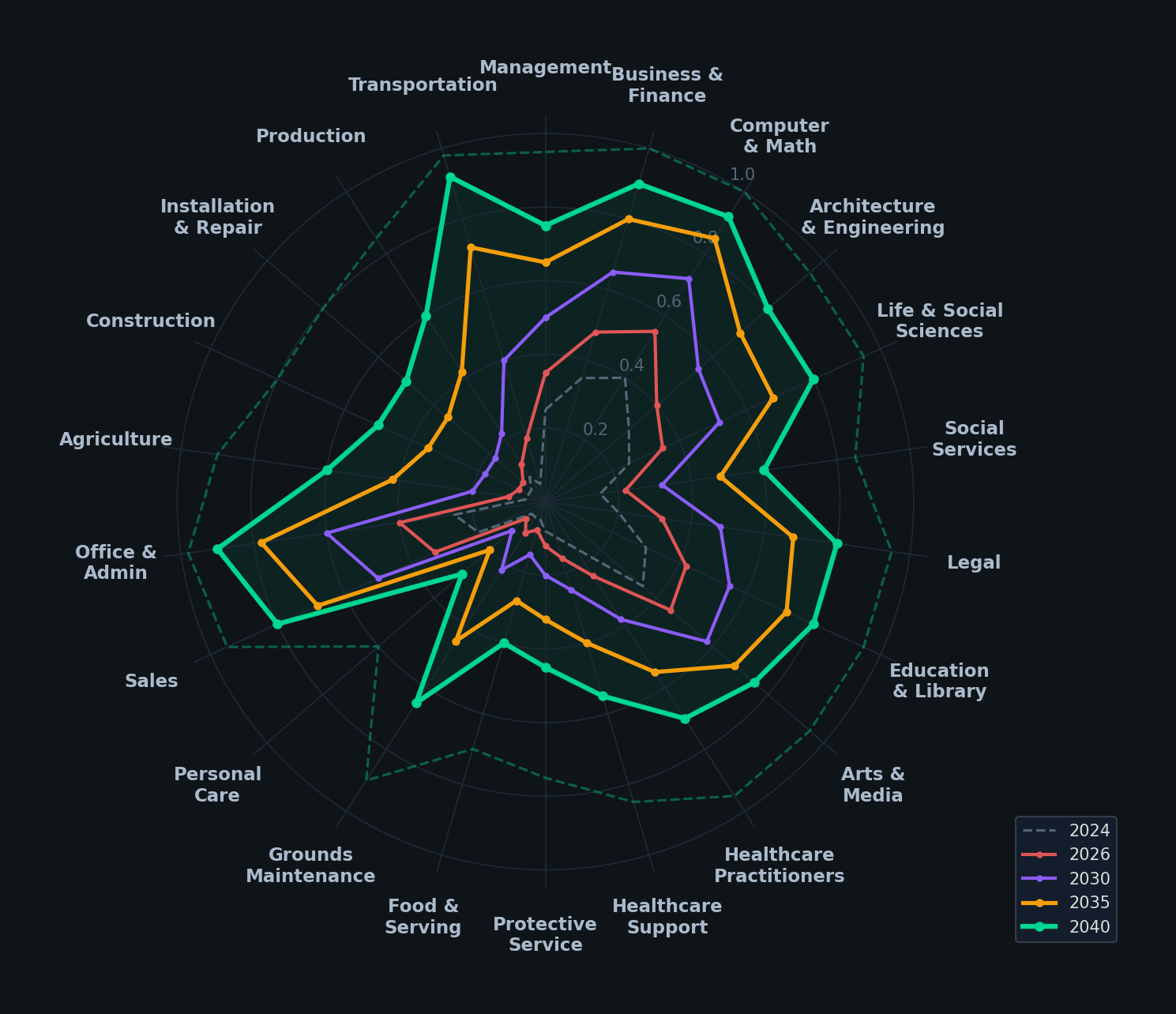
Dashed = 2024 baseline · Red solid = 2026 (where we are now) · Solid = 2040 projections
2024 → 2026
The knowledge blitz
AI floods white-collar work

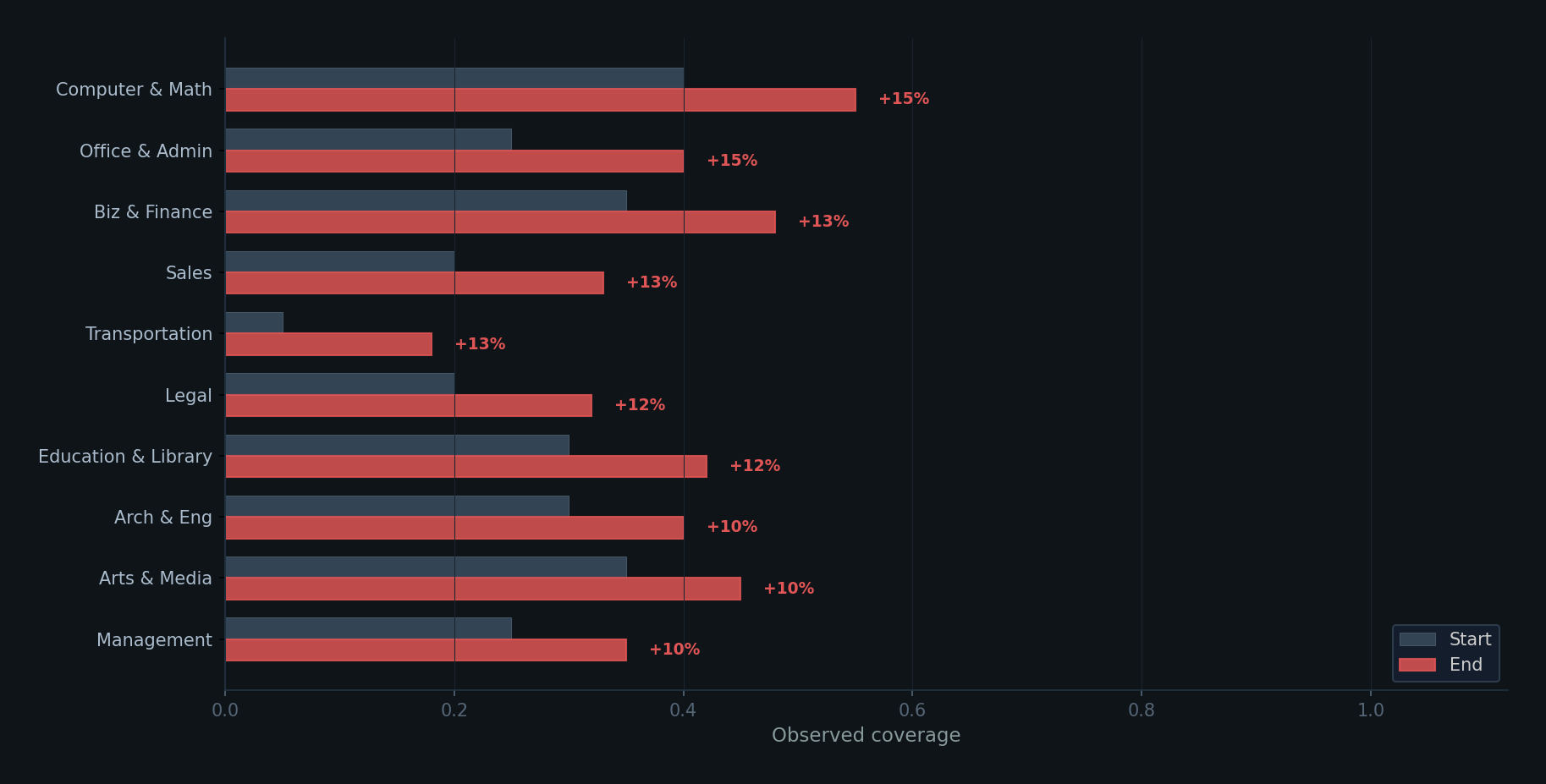
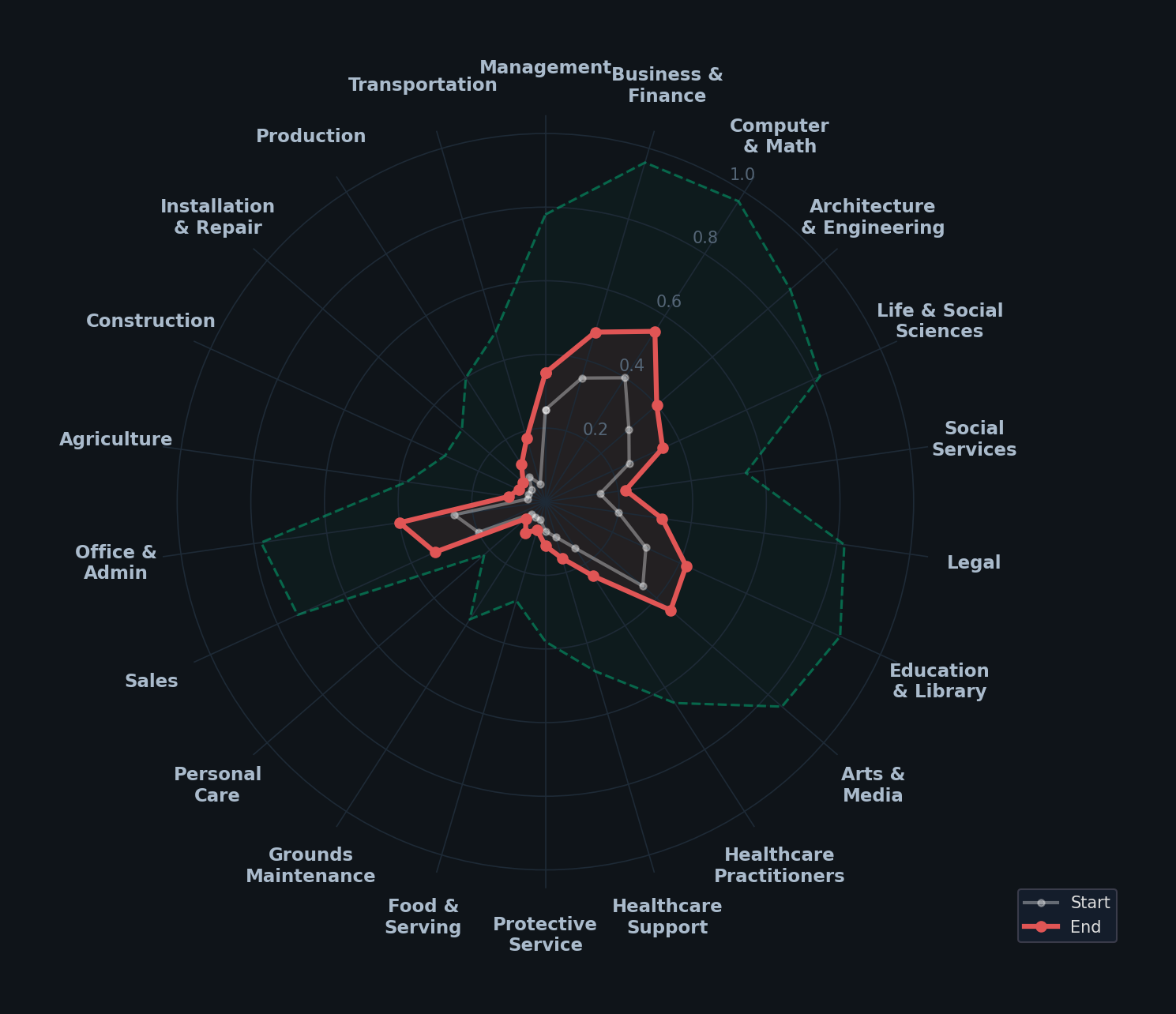
We're two years into the post-ChatGPT era and the knowledge-work categories have already moved significantly. The 2026 observed line sits noticeably outside the 2024 cluster - not dramatically, but enough to see the direction.

Comp & math
0.55
↑ from 0.40
Biz & finance
0.48
↑ from 0.35
Legal
0.32
↑ from 0.20
Office & admin
0.40
↑ from 0.25
Code generation
GitHub Copilot is table stakes. Claude, GPT-4, and Gemini aren't novelties anymore - they're embedded in daily workflows at every major tech company. Cursor, Devin, and a wave of autonomous coding agents are pushing code generation toward 40%+ of new commits.
Financial modeling
What took analysts days now takes minutes. AI doesn't just crunch numbers - it generates the models, stress-tests assumptions, and drafts the narrative around the results.
Legal research
Harvey, CoCounsel, and a dozen competitors can review contracts and pull case law faster than any first-year associate. Big Law is quietly restructuring leverage models.
Education
Khanmigo, Duolingo Max, and an explosion of edtech startups are personalizing learning at a scale no single teacher ever could. Coverage climbs to 0.42.
Office & admin - the quiet revolution
Scheduling, document processing, email triage, expense reports - AI handles the administrative layer almost invisibly. Most people don't even register it as “AI adoption” because it just feels like their tools got better.

The net effect: observed coverage in knowledge-work categories roughly doubles. The theoretical ceiling barely moves because AI could already handle most of this - we're just finally letting it.

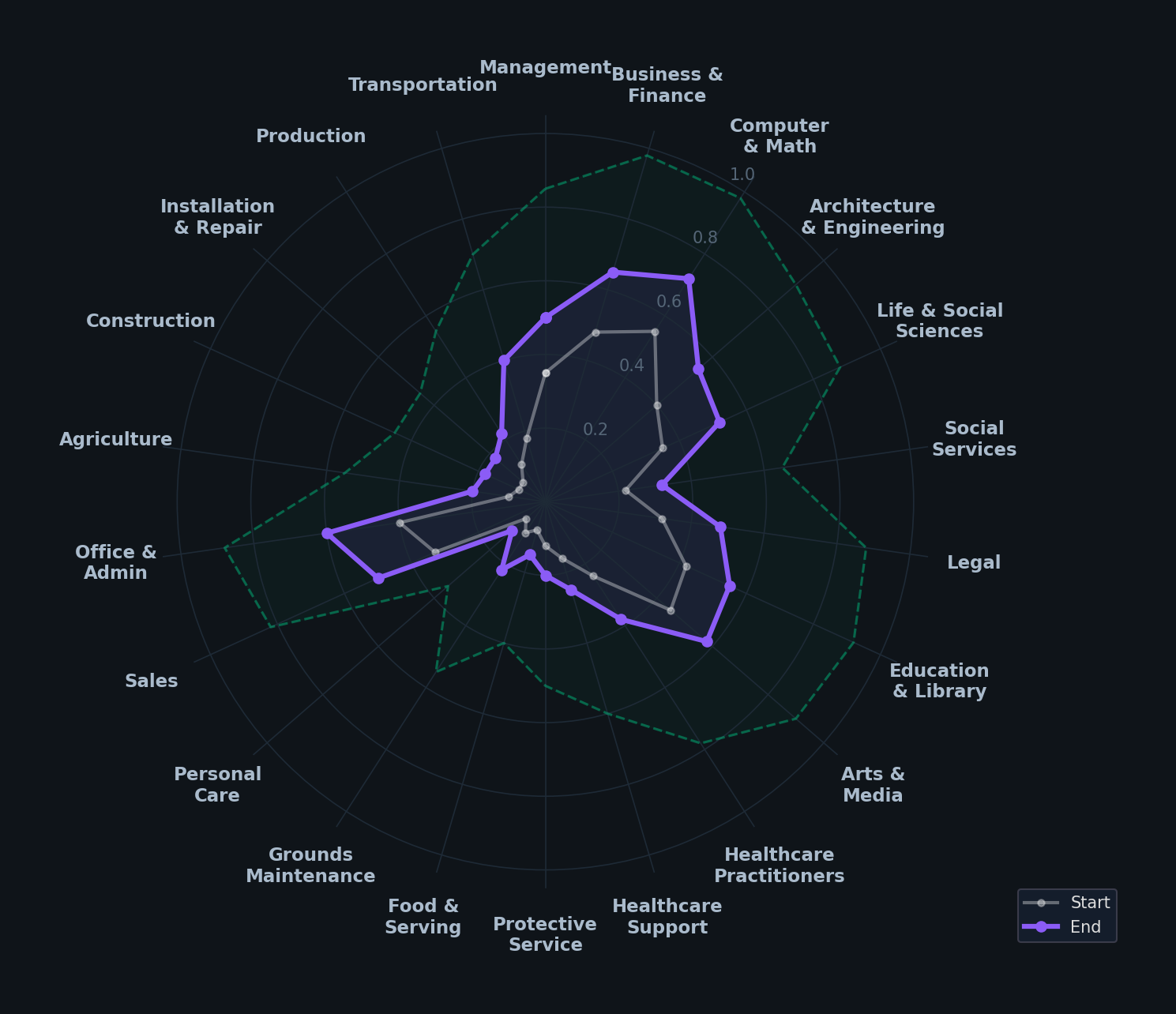
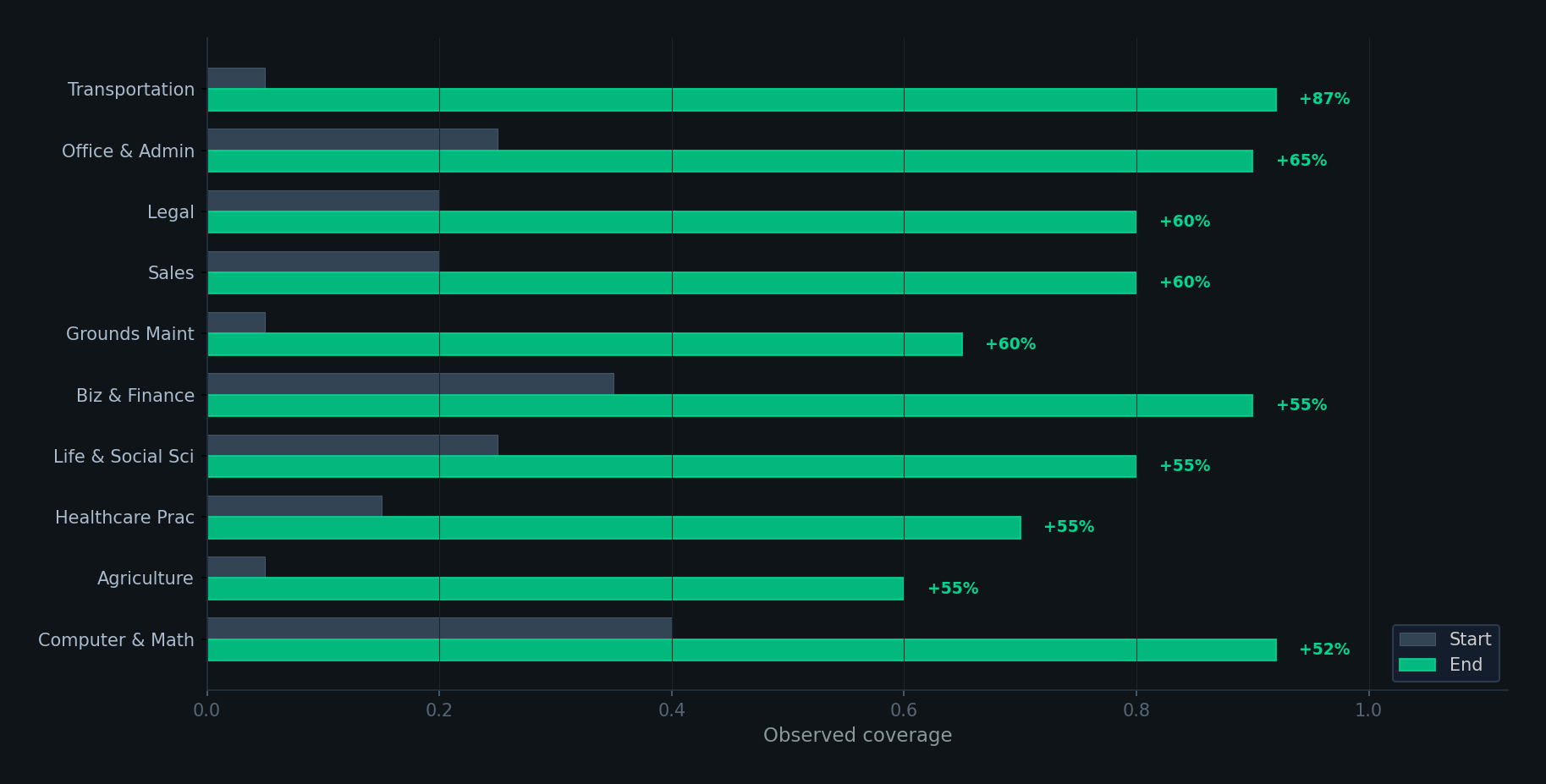
But here's the thing: the physical-world categories barely moved. Construction is still at 0.08. Agriculture at 0.10. Food & serving at 0.08. The bottom half of the radar chart is still nearly flat. That's about to change.

Double-click to enlarge
2024 to 2026 radar
Biggest movers bar chart
White = 2024 observed · Red = 2026 observed · Dashed green = theoretical ceiling
2027 → 2030
Agents take the wheel
AI stops answering questions and starts completing workflows

This is the inflection point for white-collar work. The paradigm shifts from “AI as tool” to “AI as autonomous agent.” Instead of generating a draft for you to edit, AI executes entire workflows end-to-end - and asks you to approve the output.

Autonomous sales pipelines
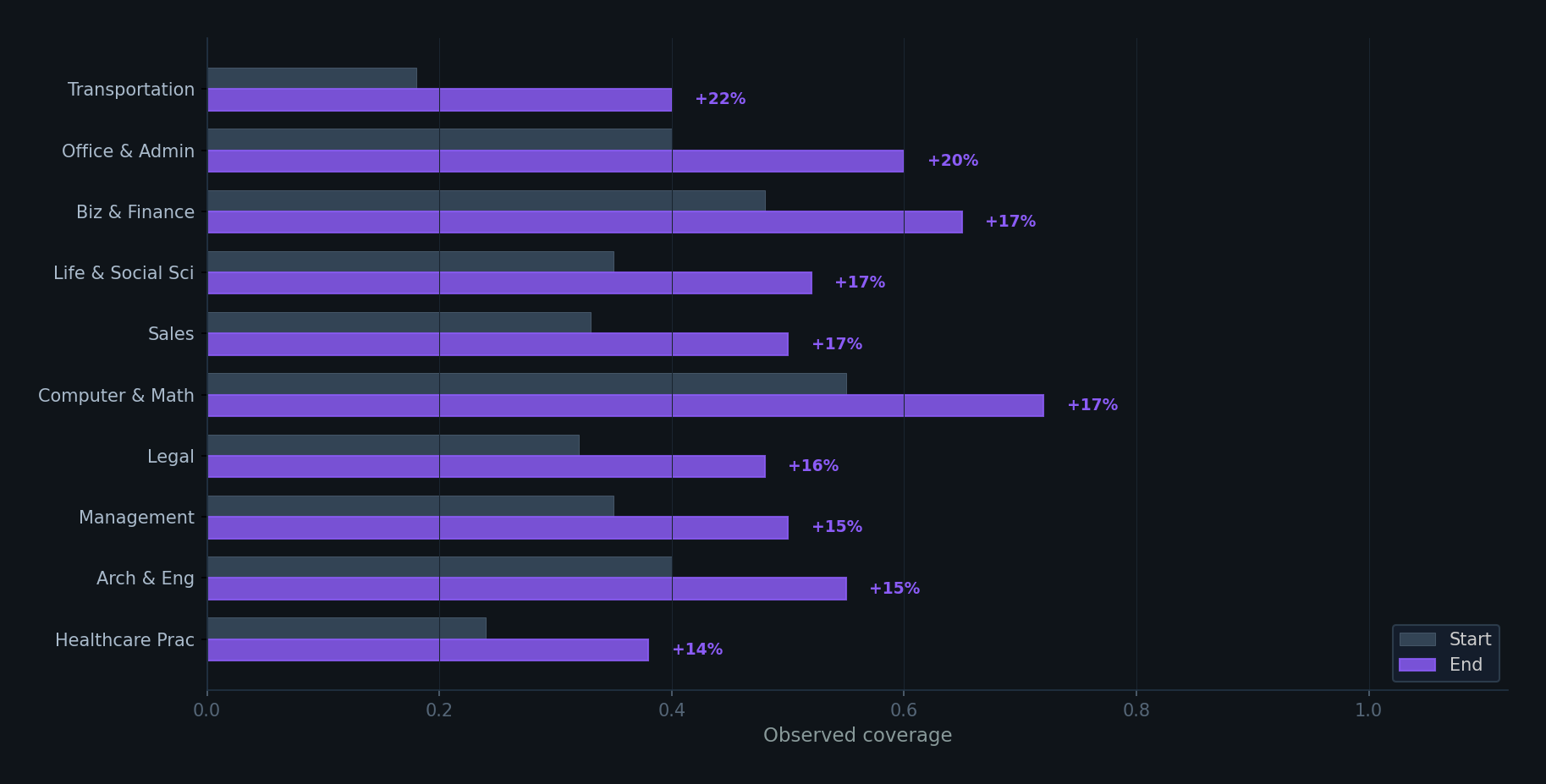
AI handles prospecting, qualification, proposal generation, follow-up, and CRM updates. The human salesperson becomes a relationship architect and deal strategist. Sales coverage jumps to 0.50.
AI manages AI
Agentic systems handle project coordination, resource allocation, sprint planning, and deadline tracking. Every manager gets an AI chief of staff that never sleeps. Management observed coverage hits 0.50.
Generative design goes default
Architecture & engineering firms use AI to produce thousands of structural options optimized for cost, materials, seismic tolerance, and regulatory compliance. Humans curate, select, and apply creative judgment. The role transforms from “designer” to “design director.”
Healthcare diagnostics cross the line
AI outperforms human radiologists in clinical practice across imaging, pathology, and early detection. Not just in controlled studies - in actual practice. Regulation remains the bottleneck, not capability. Observed coverage: 0.38.
Full self-driving approved
Waymo, Tesla, and Chinese competitors flood the market. Transportation leaps from 0.18 to 0.40 - the first physical-world category to see massive adoption. The vehicle was always a robot. It just needed the brain.
Arts & media crisis point
AI generates feature-length scripts, album-quality music, and photorealistic video. The SAG-AFTRA and WGA strikes of 2023 were the opening skirmish. By 2029, the human role has shifted to creative direction and curation. “Does anyone care that a human didn't make this?” Observed: 0.58.

The theoretical-to-observed gap in management shrinks from 0.45 to 0.20. Five years of adoption friction - regulatory approval, enterprise integration, trust, inertia - has eroded.

Double-click to enlarge
2026 to 2030 radar
Biggest movers bar chart
White = 2026 observed · Purple = 2030 observed
2030 → 2035
Robotics eats the physical world
Humanoid robots go from demos to deployment

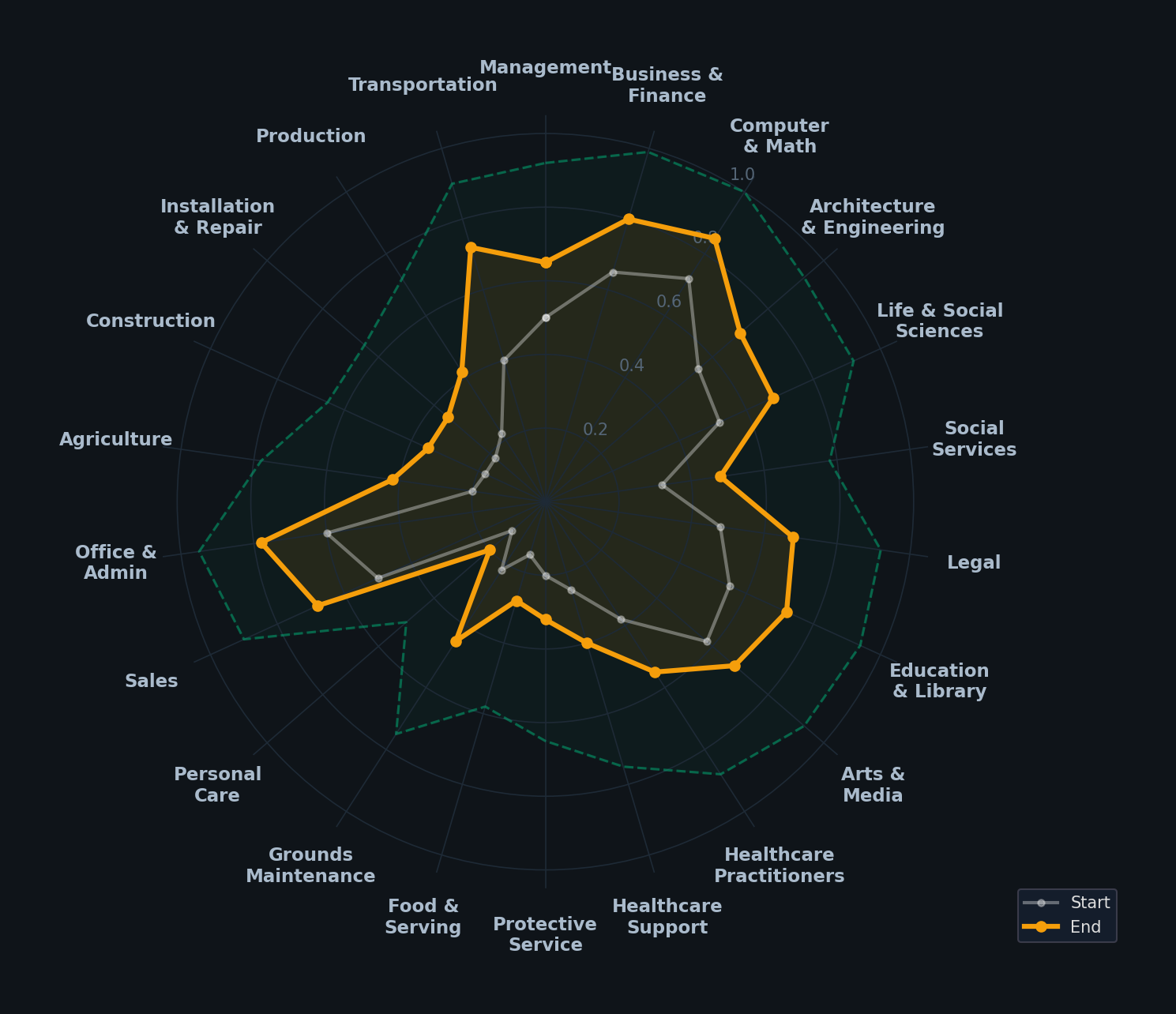
Everything before this era was software eating the knowledge economy. Now hardware catches up. The convergence of AI-level intelligence with physical dexterity and manipulation transforms the bottom half of the radar chart - the categories that barely moved from 2024 to 2028.

Humanoid robots at scale
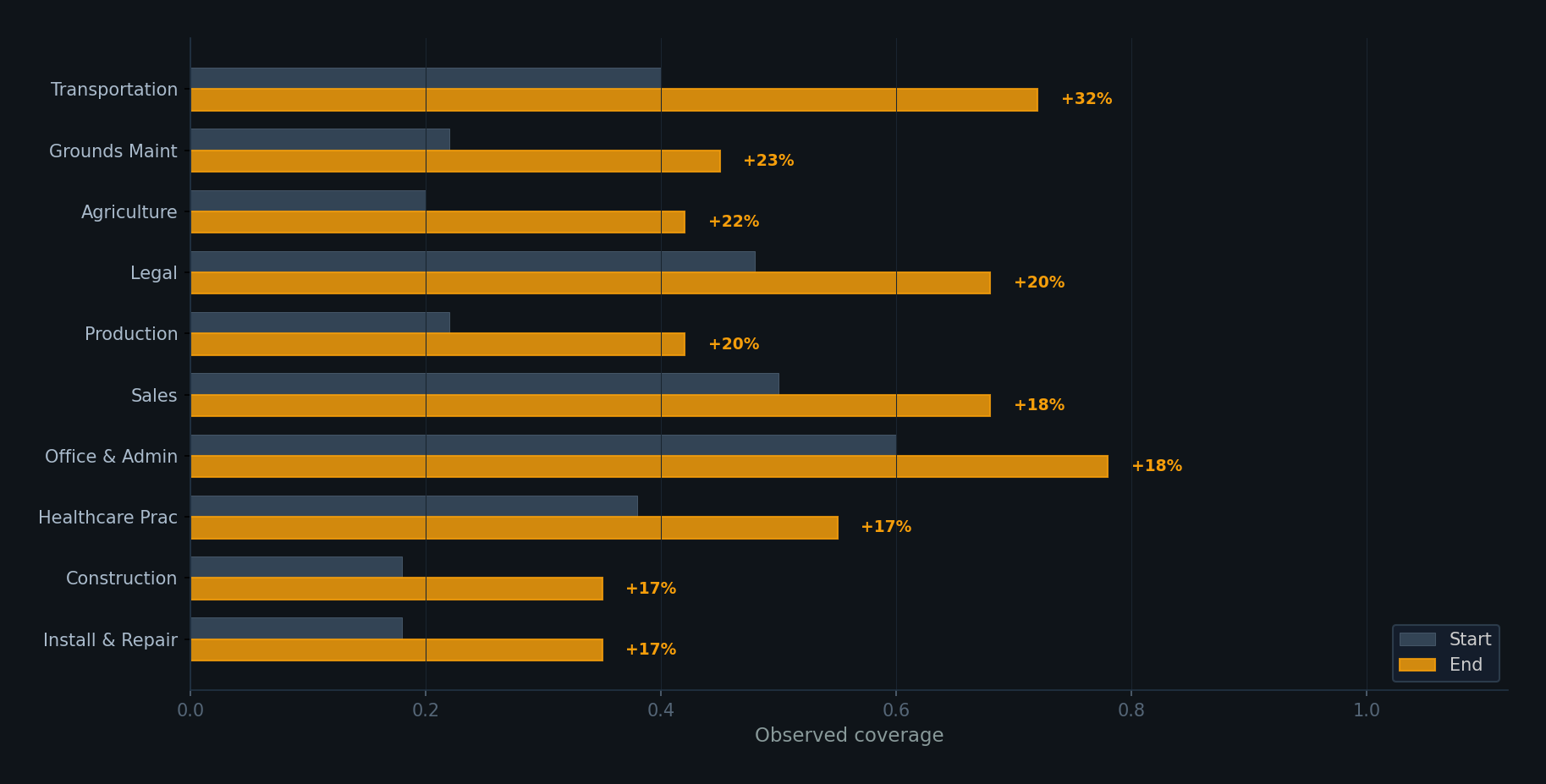
Figure, Tesla Optimus, Boston Dynamics, Agility Robotics, and a dozen Chinese manufacturers deploy in warehouses, factories, and logistics hubs. Not as PR stunts - as standard labor units running 24/7 shifts. The economics become undeniable when a humanoid robot costs less per year than a full-time worker. Production: 0.22 → 0.42.
Agricultural automation
Autonomous tractors from John Deere and CNH, drone-based crop monitoring, and robotic picking systems (the hardest problem - finally cracked by improved dexterity AI) transform farming. The agricultural labor shortage that's been building for decades meets its solution. Agriculture: 0.20 → 0.42.
Construction robotics
Robotic bricklaying, autonomous earthmoving, drone-based site surveying, and 3D-printed structures. The chronic labor shortage gets addressed by machines that work around the clock and don't fall off scaffolding. ICON, Apis Cor scale rapidly. Construction: 0.18 → 0.35.
Nano-scale drug delivery
Targeted cancer therapies using nanoparticle carriers, programmable medication release systems, and nano-diagnostic sensors push healthcare's theoretical ceiling past 0.85.
Autonomous grounds maintenance
Robotic mowers were the beginning - Husqvarna and iRobot started this in the 2020s. By 2032, full-service landscaping robots handle trimming, planting, leaf removal, and seasonal maintenance. Coverage: 0.22 → 0.45.

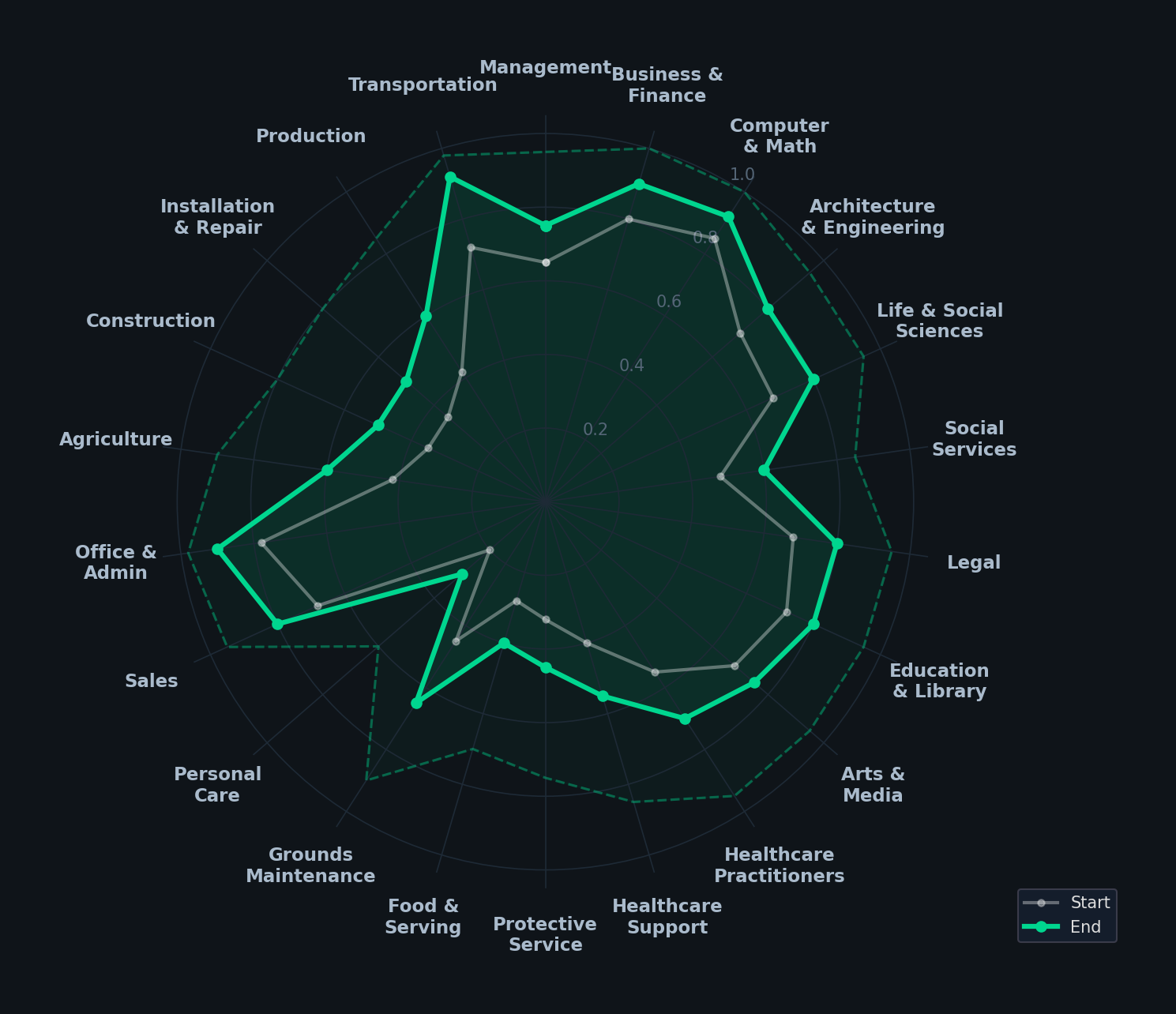
This is the era where the radar chart stops looking like a crown that only covers knowledge work and starts filling in its entire circumference. The physical world joins the AI economy.

Double-click to enlarge
2030 to 2035 radar
Biggest movers bar chart
White = 2030 observed · Amber = 2035 observed · Bottom half fills in
2033 → 2036
The convergence
AI + robotics + nano become a unified technology stack

The three forces stop being separate industries and become a unified technology stack. AI provides the intelligence, robotics provides the body, and nanotechnology provides precision at scales humans can't perceive. They compound each other - AI designs the nano-materials that make better robots that collect better data that trains better AI.

Surgical nanobots
Procedures no human hand could perform - clearing arterial blockages without open-heart surgery, targeted tumor removal at the cellular level, micro-repair of nerve damage. Healthcare practitioners' theoretical coverage hits 0.88. Observed reaches 0.55 as regulatory frameworks finally catch up.
AI-driven drug discovery
Pharmaceutical development timelines cut 70%. From molecule identification to protein folding prediction to clinical trial design to manufacturing optimization - the entire pipeline becomes AI-native. The $2.6 billion average cost to bring a drug to market collapses. Diseases that were “not commercially viable” to treat suddenly become addressable.
Smart buildings self-maintain
Embedded IoT sensors detect plumbing issues, HVAC degradation, and structural wear before they become problems. Robotic systems handle routine repairs autonomously. Your building calls its own maintenance. Installation & repair: 0.35 → 0.50.
Protective services - the deliberate gap
Autonomous surveillance, predictive threat assessment, and robotic first-response capabilities. The technology is ready. But adoption remains tempered by civil liberties debates, public trust concerns, and genuine philosophical questions about human judgment in law enforcement. Observed: 0.32 → 0.45. The gap here is intentional.
Arts & media - the provenance premium
AI generates complete feature films, albums, and AAA video games. The tools are incomprehensibly powerful compared to 2024. But the cultural conversation evolves: “how do we value human creativity when generation is free?” A new premium emerges for “human-made” work - not because it's better, but because provenance matters. Observed: 0.68.

By 2036, the average theoretical coverage across all 22 categories hits 0.90. There are almost no occupations where AI lacks the theoretical capability to handle most tasks.

2036 → 2040
The human layer
Where do humans choose to stay?

The question flips. It's no longer “what can AI do?” - it's “where do humans choose to stay?” Technology stops being the bottleneck. The theoretical ceiling is near 1.0 almost everywhere. The remaining gaps aren't capability failures - they're cultural, regulatory, and deeply human.

Personal care - the widest gap
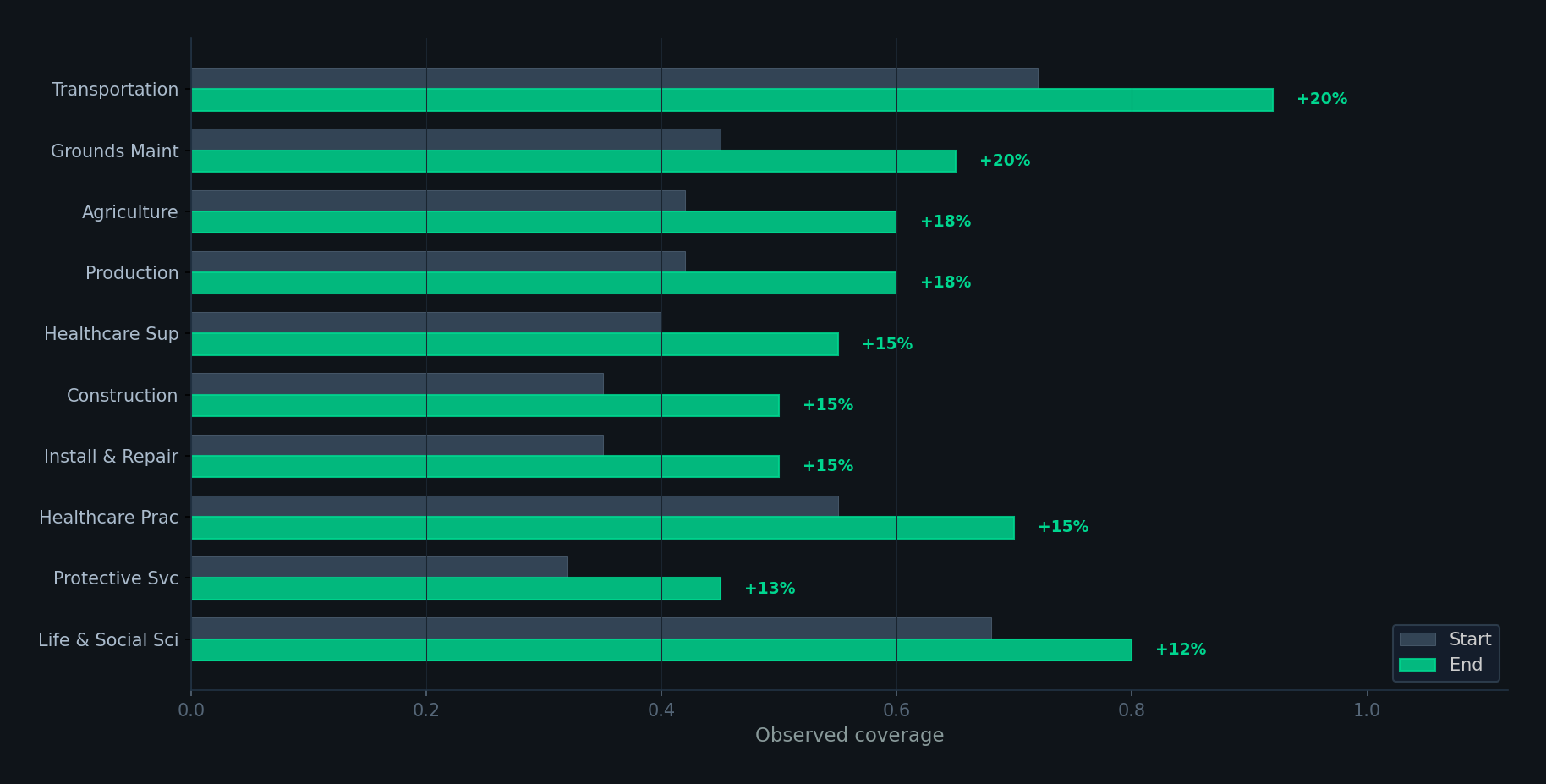
AI and robots can cut hair, give massages, provide elder care, offer companionship. The technology works. But humans want humans for these interactions. There's something irreducible about a person touching another person with care. Theoretical: 0.60. Observed: 0.30. The widest gap on the chart - and it's a choice, not a limitation.
Social services
Case workers, crisis counselors, addiction specialists, community organizers - society decides these roles require human empathy, moral judgment, and accountability in ways that AI can support but shouldn't replace. Observed: 0.60.
Food & serving - the great split
Fast food is fully automated - robotic kitchens, automated ordering, drone delivery. A McDonald's in 2038 has maybe two humans on-site. But fine dining? Still entirely human, because the performance is the product. The sommelier's recommendation, the chef's improvisation, the waiter who remembers your name. Average observed: 0.40.
Transportation - the poster child
Self-driving cars, autonomous trucks, delivery drones, last-mile sidewalk robots - 92% of observed transportation tasks are handled without a human operator. This becomes the poster child for complete AI adoption.
Office & admin - AI-native
0.90 observed coverage. The “office job” as it existed in 2024 is unrecognizable. The concept of someone spending 8 hours a day processing emails, scheduling meetings, and updating spreadsheets is as quaint as a typing pool.
Double-click to enlarge
2035 to 2040 radar
Biggest movers bar chart
White = 2035 observed · Green = 2040 observed
The full journey
2024 → 2040
From spiky mess to near-perfect circle

Pull up the progression chart. The gray 2024 cluster - that tiny blob huddled in the center - expands through red (2026, where we are now) to purple (2030) to amber (2035) to green (2040) until it nearly fills the entire circle.

Avg theoretical 2040
0.91
Avg observed 2040
0.68
Avg observed 2024
0.17
Growth factor
Double-click to enlarge
Full journey radar
Biggest movers bar chart
All five time points overlaid · Hover any data point for values

The most interesting story isn't the averages - it's the remaining gaps. The categories where the theoretical-to-observed delta stays widest in 2040 reveal where humanity draws its lines:

Personal care
30% gap
Construction
30% gap
Agriculture
30% gap
Install & repair
30% gap
Food & serving
30% gap
Transportation
6% gap
Comp & math
8% gap

These fall into three buckets. Physical deployment complexity (construction, agriculture, installation) - the robots work, but deploying them in unstructured outdoor environments remains harder than deploying software. Human-touch preference (personal care, food & serving) - we choose humans. And regulatory caution (protective services) - society intentionally slows adoption.

None of these are technology failures. They're human choices.

What this means

By 2040, the limiting factor on AI adoption isn't technology. It's culture, regulation, and human preference.

Every occupation on the chart has AI deeply embedded. The variable is the human layer on top - how thick it is, what it does, and why it's there.

The “capability gap” that defined the 2020s becomes the “choice gap” of the 2030s. The question shifts from “can AI do my job?” to “what's my role in this AI-native workflow?”

And here's the part that matters for anyone building or investing right now: the companies that win the next era aren't the ones building foundation models - those become commoditized. The winners are the companies that own the interface between AI capability and human experience. The ones building the layer where humans and AI collaborate, where the transition is seamless, and where the human contribution is meaningful rather than ceremonial.

The radar chart goes from a spiky mess to a near-perfect circle. The machines are coming for every spoke on the wheel. The only question is: where do we choose to meet them?